
The ring is the simplest part in the catalogue and the one that comes back most often. Not because the mould is hard — it is not — but because a ring fails quietly. It fits, it looks right, and three weeks later the joint weeps.
Every sizing conversation comes down to the same three numbers, plus one percentage that most drawings leave out.
Inside diameter is the sealing diameter
An O-ring or a moulded ring is specified by inside diameter (ID) and cross-section (CS). Outside diameter is a consequence: OD = ID + 2 × CS. Quotes that arrive specified by OD are the single most common error in this category, because a 2 mm wall moves the OD by 4 mm while the sealing diameter — the only one that touches the fluid — stays exactly where it was.
The second half of the mistake is stretch. A ring that has to stretch more than a few percent to sit in its groove thins its cross-section, and a thinner section seals less. As a working figure, keep installation stretch under about 5 % for a static joint; above that, the ring is fighting the groove instead of filling it. The reference numbers below are ranges used across the sealing industry rather than a rule for every compound.
Cross-section sets the squeeze
Squeeze is how much of the section is compressed when the joint closes. Too little and the ring never touches both faces; too much and the rubber has nowhere to go, so it takes a permanent set or extrudes into the gap.
| Joint | Typical squeeze | Why |
|---|---|---|
| Static, bolted cover | 15–25 % of section | Metal faces do not move; the ring only has to fill the gap |
| Static, vacuum | 15–20 % | Enough contact to hold the leak rate, low enough not to cold-flow |
| Slow movement, rod or piston | 10–15 % | Less drag, less wear, less heat at the lip |
| Thermal cycling | 20–25 % | Compression set takes a share of the squeeze over time |
These are conventional starting bands, not a specification. A 25 % squeeze is comfortable at 40 Shore A and reckless at 70 Shore A in the same groove, which is why the hardness conversation and the sizing conversation belong together.
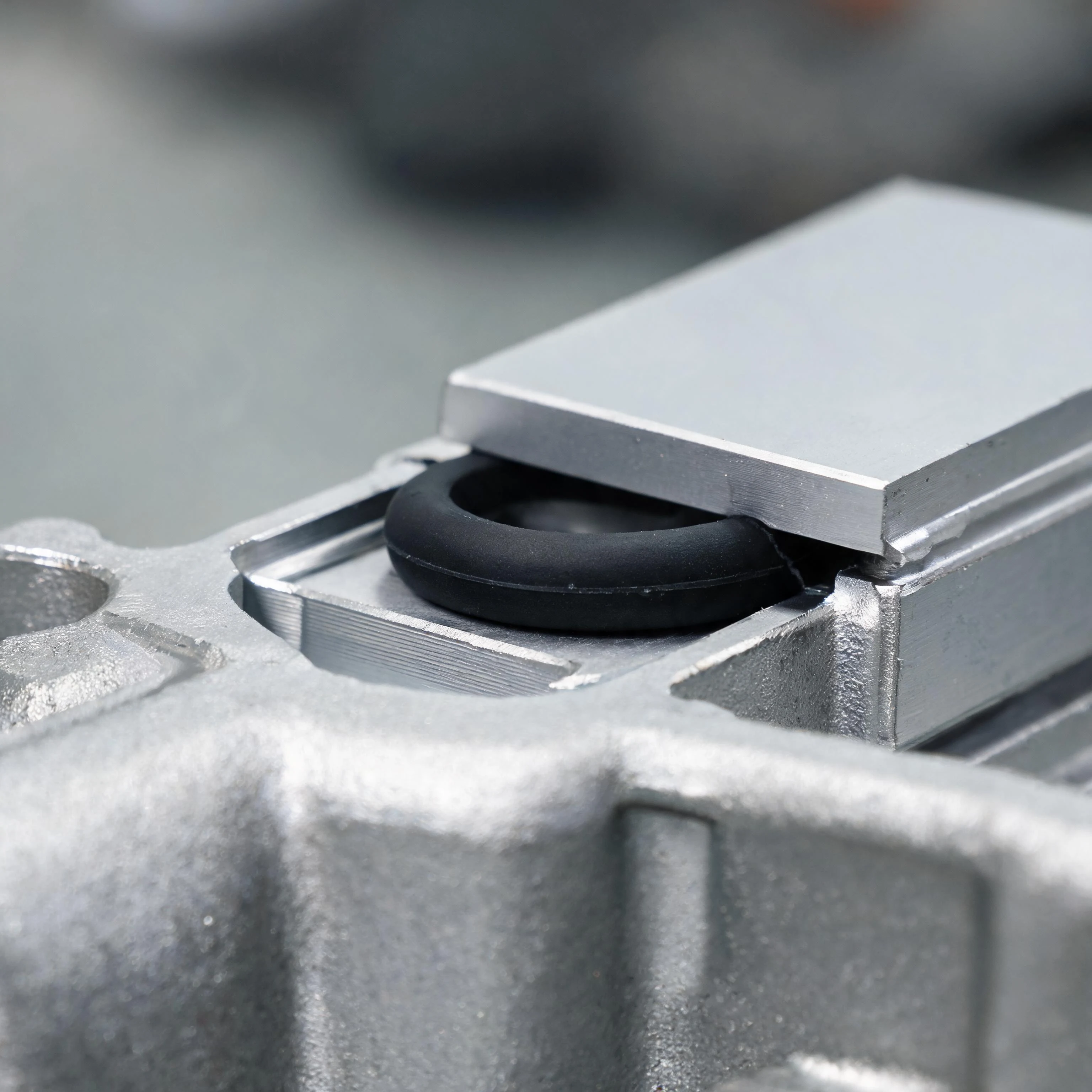
Groove fill decides whether it extrudes
Groove fill is the share of the groove volume occupied by the ring once installed. Fill it too far and the compound has no free volume to move into when pressure arrives; the seal then behaves like a hydraulic press on itself and pushes a sliver of rubber into the clearance gap.
| Application | Groove fill (reference) | Symptom when exceeded |
|---|---|---|
| Static radial seal | 60–85 % | Extrusion at the low-pressure side, nibbled edges |
| Static face seal, vacuum | 55–75 % | Slow leak that reads as outgassing |
| Slow dynamic | 55–70 % | Heat build-up, then a hard, glazed surface |
Fill is calculated, not guessed: groove cross-section area (width × depth, minus any chamfer) against ring cross-section area. It is the one check that catches a design before steel is cut, and it takes about two minutes.
What changes when the compound changes
The size does not move when you change compound, but the behaviour does. Higher hardness resists extrusion and holds a shape; lower hardness conforms to a rough face and seals at lower closing force. Compression set is what limits both: a compound that keeps 60 % of its original squeeze after a thermal cycle still seals, one that keeps 20 % does not. The trade at the two ends is set out in Choosing between 30 and 70 Shore A.
For a ring, the practical order of decisions is: groove geometry, then section shape, then hardness, then compound. Changing the material to fix a groove problem is the most expensive way to stay wrong.
What we check before quoting
Three lines on a drawing answer most of it: ID, CS, and the groove dimensions. With those we return the fill percentage, the squeeze at your stated hardness, and the tooling route — platform size, insert change, or a new mould. The silicone seal ring page carries the reference specification; the AS568 O-ring page covers the standard sizes that need no tool at all.
These are sealing rings. The wearable band is a different part with its own sizing logic — see silicone ring, wedding band and active ring on the gifts shelf.
All figures in this note are reference ranges drawn from published sealing practice and standard material data, not measurements of a specific part. Confirm them against your own groove and drawing — we will, before a price is issued.
Send the three numbers and we will return the fill, the squeeze and the tooling route.