
Most heater enquiries arrive as a paragraph: a size, a temperature, and a wattage copied from the heater it replaces. That is enough to start, and not enough to quote well. The difference between a two-week loop and a two-day one is usually five numbers and a drawing.
1. Size and shape — the drawing, not the dimensions
The circuit is laid out to the outline, so the outline is the first engineering input, not a line on a purchase order. Two heaters with identical length and width can have different watt distribution, different lead exit points, and a sensor in a different place — and the part will perform differently in the same machine.
Send the drawing with the lead exit, the sensor position, and any holes or cut-outs. If the heater replaces an existing part, send a photo of the old one next to a ruler; it catches the detail the drawing forgot.
2. Watt density — the number with a cliff
Watt density is total power divided by heated area, and it is the number that most often gets copied without being understood. The working band is 0.4–10 W/cm², but the top half of that band is conditional.
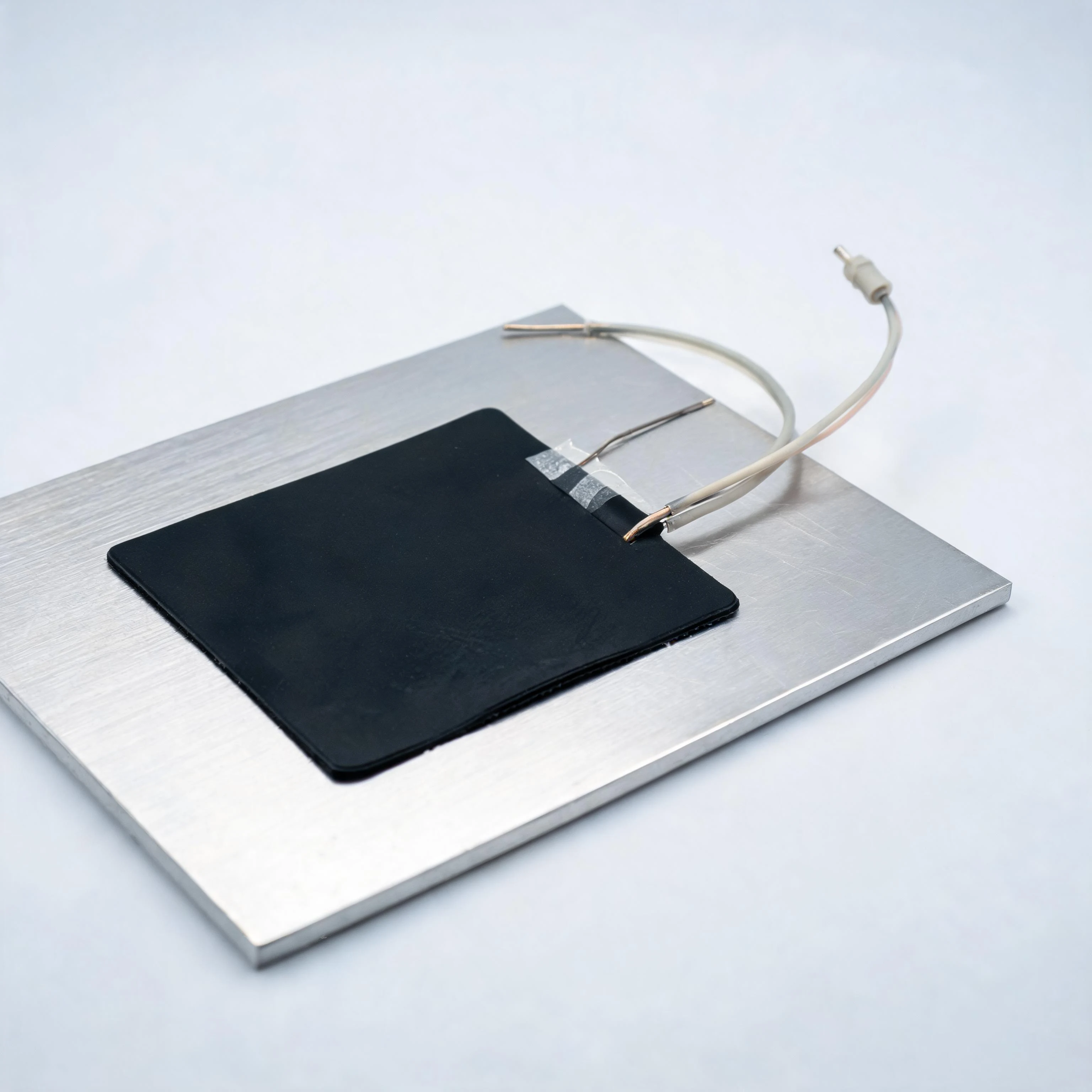
On metal, above roughly 2.5 W/cm², heater life stops following the compound and starts following contact quality: how flat the surface is, how hard and how evenly the part is clamped, how thick the metal is. A 6 W/cm² heater on a clamped, machined aluminium plate is ordinary; the same heater on a slightly bowed plate fails at the edge, where contact is worst.
Rule of thumb for a first conversation: below 2.5 W/cm², PSA attachment is usually fine. Above it, plan for clamping or vulcanized bonding, and tell us what the mating surface looks like.
3. Temperature — it sets the compound, not the watts
Continuous operating temperature picks the silicone grade and the post-cure schedule. Up to 200 °C continuous is the normal ceiling for a silicone heater; the number matters less for the circuit than for the bond, because the bond is the part that ages. If the surface runs hotter than the setpoint — small plate, poor airflow, tight enclosure — say so: an overshoot of 20 °C is a different specification from a steady 150 °C.
4. Voltage — which construction you get
The range runs 12–480 V. Low-voltage, high-current builds are wire-wound; most other builds are etched foil. That is not a preference, it is a consequence: a 12 V heater at useful power draws a current that needs a heavier conductor than foil can offer, while foil gives you an even watt distribution and a thinner part.
For battery and vehicle work, 12–48 V wire-wound is the usual answer. For a 230 V sealing bar, foil.
5. Attachment — and the 150 °C line
Three options: pressure-sensitive adhesive, vulcanized bonding, or mechanical clamping. PSA is clean and fast and suits smooth metal below about 150 °C. Above that, the adhesive is the weakest layer in the stack and the heater will tell you about it later. Vulcanized bonding makes the heater part of the part; clamping is removable and is the right choice for high watt density on a serviceable surface.
Plus: sensors laminated in
Thermocouples, PT100/RTD elements, thermostats and thermal fuses can be built into the heater during lamination. It is cheaper than a retrofit, more accurate than a sensor taped to the outside, and it removes a field wiring step. If the heater protects itself with a thermal fuse, that fuse belongs inside the same laminate — otherwise it protects the cable, not the part.
Two things we will not quote
Fuel and aromatic oils: silicone swells, and FKM is the correct material. And a metal-sheath job at very high watt density on a rough casting: the surface, not the heater, is the limiting part, and quoting it would only move the problem to your warranty.
The build itself — compound, lamination, inspection — is described in Why silicone heaters bulge and delaminate. Reference figures are on the silicone rubber heater page.
Send the five numbers and the drawing, and we will come back with the build and the price.