
Every silicone band we sample comes back with the same note: size 9 is loose, size 8 is tight. Usually nothing is wrong with either ring. The two were measured at different times of day, or one was 7 mm and the other 9 mm, and neither buyer was told that width changes the size they need.
The finger is not a fixed diameter
A finger changes size across a day, with temperature, salt and altitude. Two millimetres of finger circumference — half a ring size — is a normal swing between a cold morning and a warm evening, and a heavier swing after a long flight or a salty meal. That is why a band that feels right at 9 am can spin at 6 pm, and why fitting advice that ignores time of day produces returns.
Practical consequence for a private-label programme: fit samples are taken twice, morning and late afternoon, and the size that appears in both is the size you stock.
Measure circumference, not the old ring
A worn band is not a circle any more. Daily wear flattens the shank, so its inner diameter reads smaller than the finger it fits. Measure the finger instead: a strip of paper around the base, marked where it overlaps, then measured flat.
Three checks that remove most sizing errors:
- Measure the base of the finger, not the knuckle or the middle phalanx.
- Check the band will pass the knuckle — a ring that fits the base but not the joint will be taken off and lost.
- Measure both hands. One is usually half a size larger, and it is not always the dominant one.
Width changes the size you need
A band is a pressure distribution problem. A wider band spreads the same grip over more skin, so a 9 mm band feels tighter than a 7 mm band of identical inner diameter. The rule of thumb in the trade is half a size up per step in width; on a cold finger it can be more.
| Band width | Feels like | Good for | Watch out for |
|---|---|---|---|
| 6–7 mm | The size on the label | Narrow hands, easy removal, daily swap | Rolls more on a bar or a handle |
| 8 mm | Roughly half a size tighter | Wedding bands, all-day wear | The common compromise; check the knuckle |
| 9 mm | A full size tighter | Gym and site work, engraving area | Harder to remove when hands swell |
These bands are conventional, not a specification: a soft compound at 40 Shore A reads tighter than the same width at 60 Shore A, because it conforms instead of bridging.
Hardness: comfort against grip
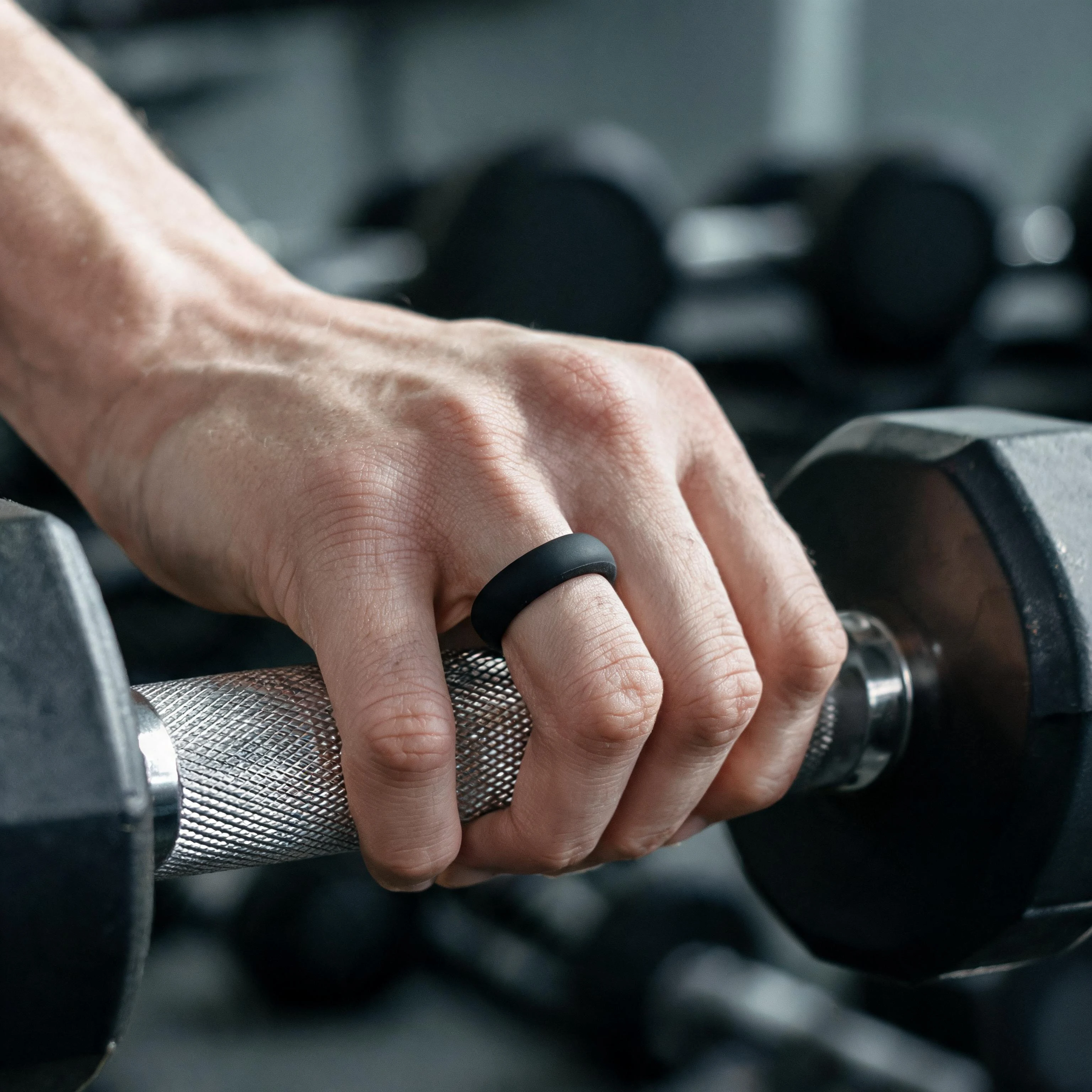
Hardness decides whether the band conforms or holds its shape. Softer compounds sit comfortably and release easily; harder ones resist rolling when something slides across them, which is the whole point of wearing a band to the gym.
| Hardness | Behaviour | Typical use |
|---|---|---|
| 40–45 Shore A | Soft, conforms to the finger, low grip | Wedding bands, sleeping in it, sensitive skin |
| 50 Shore A | The balanced middle | Most private-label bands |
| 55–60 Shore A | Firmer, resists rolling, holds an edge | Gym, workshop, outdoor work |
Colour, engraving and what wears first
Colour is compounded into the silicone rather than coated, so a black band stays black at the edges; a white or sand band shows hand cream and graphite dust within a week, which is a stock decision rather than a quality problem. Inner-band engraving survives because it sits against the skin, out of abrasion; outer-face logos wear at the high points first, so a debossed mark outlives a raised one.
Cleaning is soap and water. Silicone-based lubricants and some sunscreens leave a film that takes the matte finish with it — worth a line on the retail card.
What we confirm before a run
Four things settle a ring order: the size set (with half sizes if you stock them), the width, the hardness, and the engraving file. With those, sampling is one round instead of three. The silicone ring product page carries the reference table; the wristbands page covers the same compounds in event bands.
All sizes, widths and shore values here are reference ranges from common practice in the silicone-band trade, not measurements of a specific lot. Confirm against a physical size set before you print packaging.
Send the size set, width and hardness and we will quote the run.