
Category 02 · Kitchen & home | Ice trays, three formats | Updated 2026-11-05

Silicone ice cube trays, 30–80 Shore A, food-contact grade

Three tray formats on existing tools, platinum-cured compound, 500 pcs per colour and 10 working days counted from the purchase order.

Both buttons carry this part into the form. Finished part, or a change to the geometry: the second one starts with your drawing.

Size domainThree tray formats, ±0.05 mmOverall size to ISO 3302-1 Class M2; rim flatness TIR ≤ 0.02 mm measured on granite.
Compound & hardness30–80 Shore A, −60 to 230 °CPlatinum-cured, declared to FDA 21 CFR 177.2600, EU 1935/2004 and LFGB.
MOQ & lead time500 pcs, 10 working daysThe clock starts at the purchase order, on an existing tool, one colour per run.
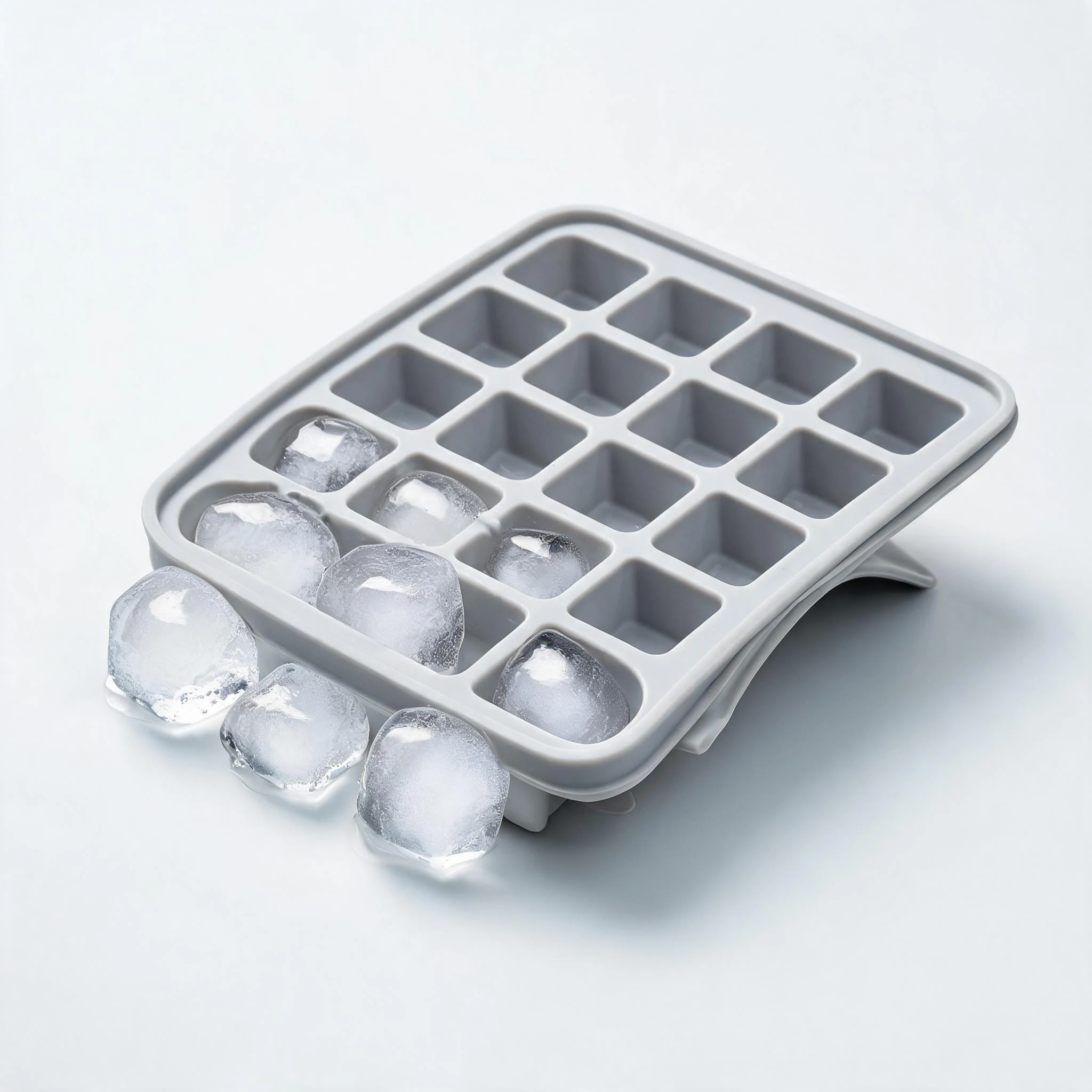
Silicone ice cube tray — food-contact platinum-cured tray, reference image
Reference image only — the tray releases by flexing the base. Cavity layout and rim thickness are set by the tool, not by this photo.

01 — What it is

One paragraph, no adjectives

Definition

A silicone ice cube tray is a flexible food-contact mould used for freezing water, stock or purée into cubes that release by bending the base rather than by force. It is made by compression or LSR injection moulding from a platinum-cured compound, then trimmed and packed.

The functional decisions are the floor thickness (it has to bend at freezer temperature) and the rim stiffness (it has to stay flat when the tray is stacked). Everything else — colour, cavity count, packaging — runs on top of those two.

02 — Specification

Every cell carries its measuring basis

Specification

PropertyValueMeasured by
FormatsThree: standard tray, deep tray, narrow bar trayDrawing, per format
Overall size±0.05 mmISO 3302-1 Class M2
Rim flatnessTIR ≤ 0.02 mmDial gauge, part at rest on granite
Hardness30–80 Shore AISO 7619-1, stacked specimen
Temperature−60 to 230 °CISO 188 after ageing
CompoundPlatinum-cured, food contactFDA 21 CFR 177.2600 · EU 1935/2004 · LFGB
ColourPantone match, food-contact pigmentsMaster chip under D65
Post-processingHand trim; optional rim markFirst article, then AQL sampling
MOQ500 pcs per colourPer purchase order
Lead time10 working daysFrom purchase order, existing tool

03 — Options

What each choice buys and costs

Two decisions you will actually make

Compound and finish. Everything else on this part follows from those two, and both are settable on the existing tool.

Compound 3 routes

What the compound buys

Platinum-cured, food contact. The default: no peroxide by-products, no odour after repeated freezing. It costs more per kilogram than peroxide-cured stock, and we quote it as standard on this part.

Translucent. You can see the fill line and whether the tray is clean. It also shows scratches and hard-water marks that an opaque tray hides.

Opaque colour match. Hides staining and freezer marks. The trade is a chip approval step before the run, which adds a week to the schedule, not to the tool.

Post-processing 3 routes

What the finish costs

Hand trim. Fastest on small runs. The edge is judged against the master sample, so the standard is a person, not a gauge.

Cryogenic deflash. A cleaner edge at volume. It adds a handling step and a minimum batch, and it is the route we recommend above a few thousand pieces.

Retail packaging. Boxed sets sell. It adds a packing step, a carton minimum and a separate line on the quote — it never changes the part price.

04 — How it is checked

Inspection, sampling, documents

How it is checked

CheckMethodSampling
First articleCMM and gauge across the cavity layout; rim flatness on graniteEvery format, before the run
HardnessISO 7619-1, three points per partOne part per cavity, per lot
AppearanceVisual against the master chip under D65ISO 2859-1, general inspection level II
Food contactCompound certificate checked against the declarationEvery lot
PackingCount, colour and carton markEvery carton

Documents that ship with each lot: certificate of analysis, dimensional report, compound certificate with the food-contact declaration, packing list. A per-lot photograph of the first part is available on request.

05 — Pricing basis

Units, tool status, clock

What the number is quoted against

  • Unit of pricePer 1,000 pcs, one colour, existing tool. The band the price belongs to is printed on the quote, not on this page.
  • ToolingNo tooling charge on the three formats. A new geometry is quoted as a separate tool line, and the tool stays in the programme it was built for.
  • Lead time clockFrom the purchase order on an existing tool. On a new geometry the clock starts at drawing approval, not at the enquiry.
  • What moves the priceCavity count, colour (a second colour is a second run), deflash route and packaging. Not the drawing.

06 — FAQ

Four questions buyers ask first

Answered on the drawing, not by email

Will the cubes release without cracking the tray?

It releases by flexing the base, not by force. At 30–80 Shore A the floor is thin enough to bend at freezer temperature; a tray that is clamped flat, or a cavity with an undercut, tears at the rim instead.

Is the compound food contact?

Yes. The compound is platinum-cured and declared to FDA 21 CFR 177.2600, EU 1935/2004 and LFGB. The declaration travels with each lot, with the compound certificate.

Can I print a logo on the tray?

Not on the food-contact surface. A colour change runs on the existing tool from 500 pcs; branding goes on the rim mark or on the packaging instead of the cavity face.

What is the MOQ and the lead time?

500 pcs per colour on an existing tool, 10 working days counted from the purchase order. A new geometry is quoted with its own tooling line and its own clock, starting at drawing approval.

07 — Related

Notes, projects, adjacent parts

Where to go next

Technical notes
OEM / ODM
Adjacent parts
Your drawing Send a drawing

Tray outline, cavity layout and the colour reference. A DFM note comes back in 48 hours, with what will not mold called out in writing.

Start a DFM review →
Your question Ask an engineer

Floor thickness, rim stiffness, deflash route: three answers that decide the tool. Ask before the drawing is frozen.

Send the question →